 Solo Menus
Features
Everything your restaurant's website needs, already built
Here's what every restaurant website should do, what each feature is, and why it matters to your guests. Every Solo Menus site comes with all of it, free.
Build my free siteFeature 02
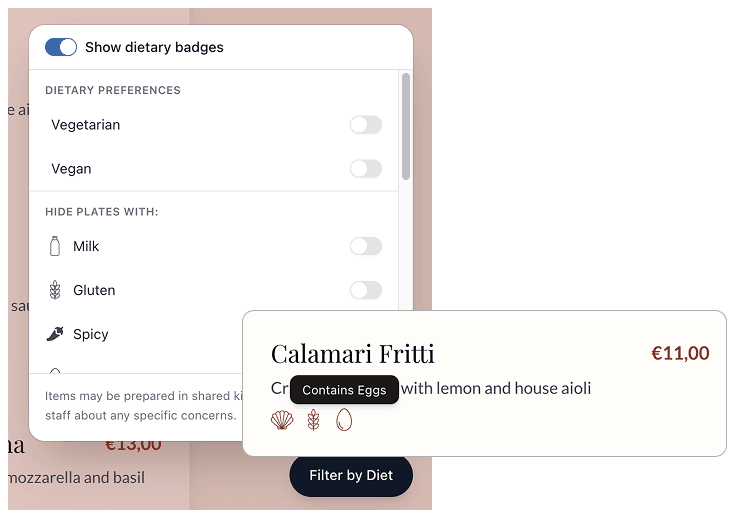
Allergen and dietary labels
What it is
A clear mark on each dish showing which of the 14 major allergens it contains, plus vegetarian, vegan and spicy labels, and a short note inviting guests to ask your staff.
Why it matters
In the EU, restaurants have to be able to tell customers which of 14 listed allergens are in each dish (Regulation 1169/2011), and the UK uses the same list. Beyond the law, guests with allergies choose where to eat by how easy this is to check before they arrive.
Feature 03

Your menu in your guests' languages
What it is
Your menu and restaurant details in more than one language, with a switcher so each guest can pick theirs.
Why it matters
Tourists, expats and neighbors who are more comfortable in another language all check the menu before they walk in. A menu they can read is a menu they can order from, and a translated dish is far less intimidating than one they have to guess at.
Feature 04
Hours, address and contact
What it is
Your opening hours, address, phone number and social links, set up so a guest can tap to call you, message you or get directions.
Why it matters
"Are they open now?" and "How do I get there?" are among the first things people check. If your own site doesn't answer them, the answer comes from wherever else it can be found, and that's often out of date.
Feature 05

A look that feels like your place
What it is
Your logo, colors, fonts and a cover photo, so the site feels like walking through your door rather than a template.
Why it matters
Guests judge a restaurant by its feel before they taste anything. A site that looks like your place builds trust; a generic template reads like a chain, or like nobody's looking after it.
Feature 06
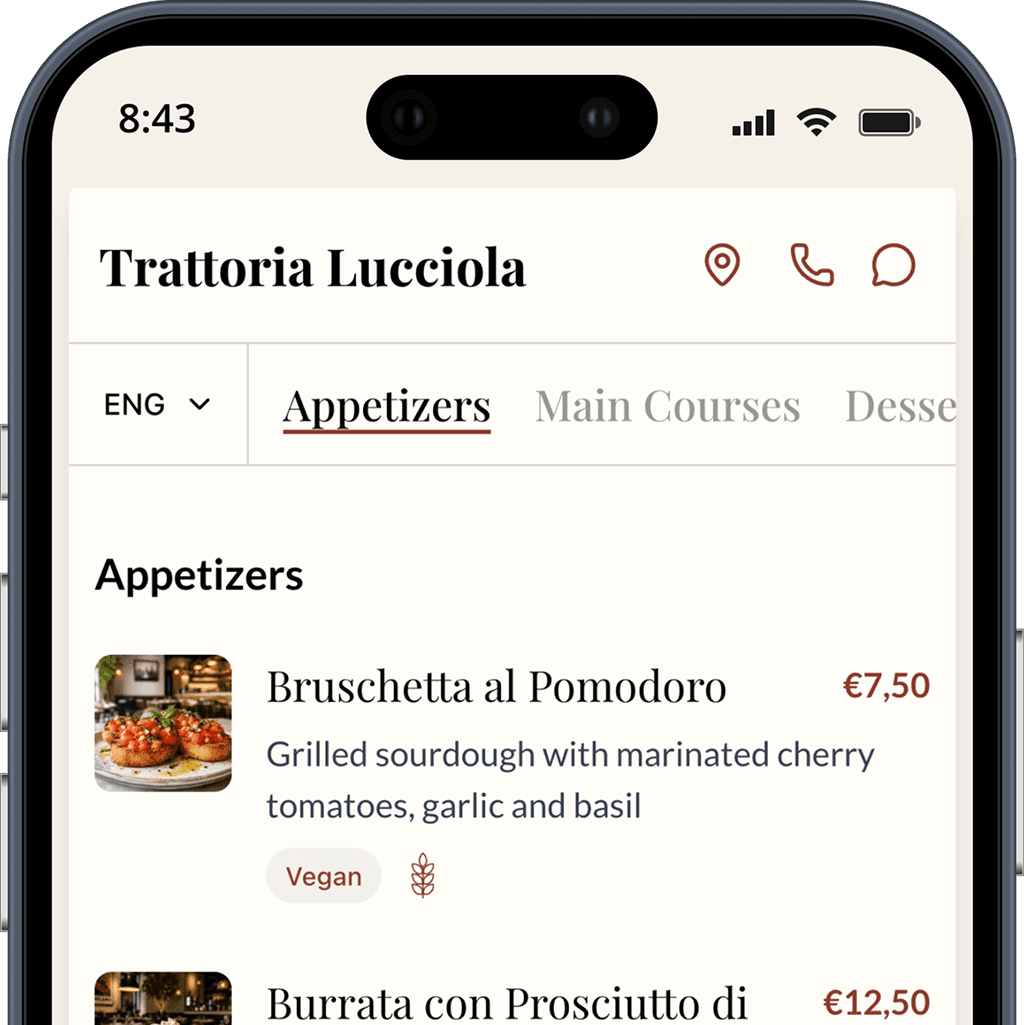
Built for phones first
What it is
A single page designed for a phone screen before anything else: text big enough to read, buttons you can hit with a thumb, and menu sections you can jump between.
Why it matters
Most people looking up a restaurant are on their phone, often standing outside it, or sitting at the table after scanning your QR code. If they have to pinch and zoom, many of them give up.
Feature 07
Fast, even on a weak signal
What it is
A site that shows up almost instantly, even on a patchy mobile connection or the Wi-Fi in a basement dining room.
Why it matters
Every second of waiting loses people, especially someone at your table trying to decide what to order. Speed counts for search too: Google favors pages that load quickly on phones.
Feature 08
A web address
What it is
The address people type or tap to reach your site: the one you print on your menu, paste into your Instagram bio and add to Google.
Why it matters
It's how every other channel points back to you. A short, clear address that matches your name is easier to remember, share and trust.
Feature 09
A QR code for your tables
What it is
A square code on your tables, window or menu cover that opens your menu on a guest's phone when they point their camera at it.
Why it matters
You stop reprinting menus every time a price changes, guests can read at their own pace and in their own language, and people walking past your window become people reading your menu.

Feature 10
Found by Google and AI assistants
What it is
The behind-the-scenes information that lets search engines and AI assistants like ChatGPT understand what your restaurant is, where it is, when it's open and what it serves.
Why it matters
More and more people ask their phone, or an AI assistant, where to eat, and get an answer instead of a list of links. That answer is built from whatever information is out there. If your own site states it clearly, you become the source. If not, the answer gets pieced together from old reviews and other people's photos.
Feature 11
No cookie banner
What it is
A site that doesn't track your guests, so there's no consent pop-up standing between them and your menu.
Why it matters
In the EU, tracking cookies and analytics that need consent mean a cookie banner: the first thing a hungry guest sees, and the first thing they want to close. A site that doesn't track skips all of that, and it's one less legal requirement for you to get right.
Feature 12
Hosting, security and upkeep
What it is
The server your site lives on, the security certificate that keeps it safe, and the updates that keep everything working.
Why it matters
It's the invisible part nobody thinks about until the site goes down on a Saturday night, or a plugin update breaks the menu. Every hour spent on it is an hour away from your restaurant.
All of it, on every site, free.
No plugins, no setup, no monthly bill. Snap a photo of your menu and your site can be live in about ten minutes.
Build my free site