 Solo Menus
Allergen Labeling on Restaurant Menus: What EU Regulation 1169/2011 Actually Requires
Reading time: 6 minutes
If you serve food anywhere in the European Union, you are legally required to tell your customers which allergens each dish contains. This has been the law since December 2014, under EU Regulation 1169/2011.
What the Law Actually Says
Regulation 1169/2011 requires every food business to inform customers when a dish contains any of 14 specific allergens listed in Annex II of the regulation.
Two things are worth understanding about how this works:
- It's about those 14 allergens, not all allergens. A customer might be allergic to strawberries, but strawberries aren't on the list. The law names 14 substances responsible for the vast majority of serious food allergies and intolerances in Europe.
- How you present the information varies by country. Each EU member state decides whether the declaration must be written or can be given verbally by staff. In practice, written information on the menu is what diners expect, what inspectors are used to seeing, and the only version that doesn't depend on every member of staff remembering every recipe correctly.
The information must be accurate, specific to each dish, and available before the customer orders. A generic "our dishes may contain allergens, ask staff" sign does not satisfy the regulation on its own.
The 14 Allergens You Must Declare
These are the Annex II allergens, with what each one actually covers:
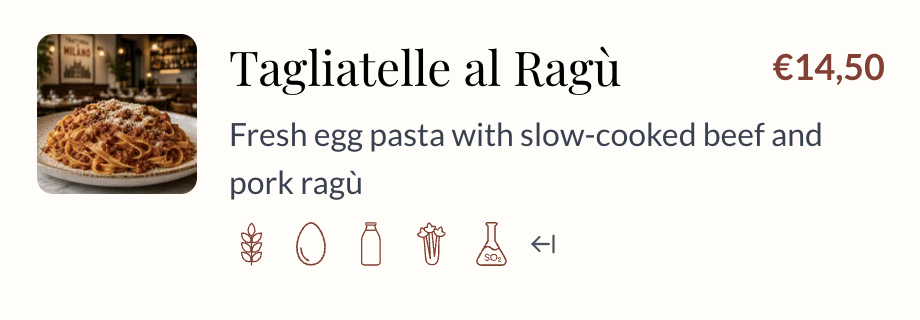
- Cereals containing gluten — wheat, rye, barley, oats, spelt, kamut and their hybridised strains
- Crustaceans — prawns, shrimp, crab, lobster, crayfish
- Eggs — from any bird species
- Fish — all fin-fish species and their products
- Peanuts — also known as groundnuts
- Soybeans — including soy sauce, soy milk, tofu and edamame
- Milk — all mammal milk and derivatives, including lactose
- Tree nuts — almonds, hazelnuts, walnuts, cashews, pecans, Brazil nuts, pistachios, macadamias
- Celery — stalks, leaves, seeds and celeriac
- Mustard — seeds, leaves, flowers and prepared mustard
- Sesame seeds — and products derived from them
- Sulphur dioxide and sulphites — above 10 mg/kg, common in wine, dried fruit and some preserved foods
- Lupin — beans, seeds and flour, sometimes used in gluten-free baking
- Molluscs — mussels, clams, oysters, snails, squid and octopus
Celery counts when it's celery seed in a spice mix. Sulphites are in most wines used for cooking. Lupin flour shows up in baked goods you bought, not made. The allergens in your dishes include the allergens in every sauce, stock, and pre-made ingredient you use.
Declare "Contains," Never "Free From"
Allergen labeling works in one direction only: you declare what a dish contains.
The absence of a label does not mean the dish is safe. It means nothing was declared. This distinction matters enormously:
- If your carbonara is marked with eggs, milk, and gluten, a customer with an egg allergy knows to avoid it. That's the system working.
- If your salad has no allergen labels, that is not a claim that it's allergen-free. Maybe it genuinely contains none of the 14. Maybe the dressing has mustard and nobody updated the menu.
Never advertise a dish as "gluten free" or "nut free" unless you can genuinely guarantee it, including cross-contamination in your kitchen. "Free from" claims carry a much higher legal bar than "contains" declarations. Declaring what's present is a legal duty; claiming what's absent is a promise you have to be able to keep in a shared kitchen.
Three Mistakes That Create Real Risk
1. Translating Allergen Names Yourself
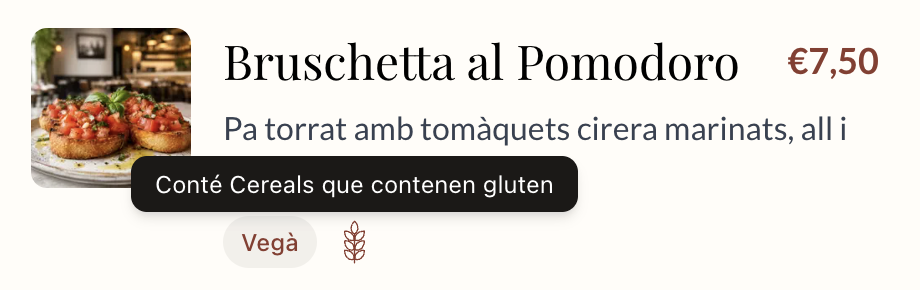
If you serve tourists, your allergen information needs to be understandable in their language. But allergen names are regulatory terms, not ordinary words. The regulation has an official translation of Annex II in every EU language, and that's the wording regulators and allergic diners expect to see.
A well-meaning translation of "tree nuts" like "nueces" (walnuts) narrows the warning and could give a cashew-allergic customer false confidence. With allergens, an almost-right translation can be worse than no translation.
2. Letting Paper Menus Drift Out of Date
Your supplier swaps the bread. The new pesto has cashews. The chef adds a splash of soy sauce to the marinade. Every one of those changes can alter a dish's allergen profile, and your laminated menu doesn't know.
Allergen information is only compliant if it's current. A menu that was accurate when you printed it and wrong today is a liability, not a defense. This is the same reason QR code menus have replaced paper in so many restaurants: a digital menu can be corrected the same day the recipe changes.
3. Relying Entirely on "Ask Our Staff"
Verbal information is permitted in some countries, but it fails in predictable ways: the new waiter doesn't know the recipes, it's Saturday night and nobody has time for a five-minute ingredient conversation, or there's a language barrier with the exact customer who needs the information most.
Written allergen information on the menu protects the customer and your staff. The conversation with staff should be the follow-up for specific concerns, not the primary source.
What About Cross-Contamination?
The regulation's allergen declaration is about ingredients — what's in the recipe. It doesn't require you to assess trace contamination risk dish by dish, and honestly, in a small kitchen you usually can't.
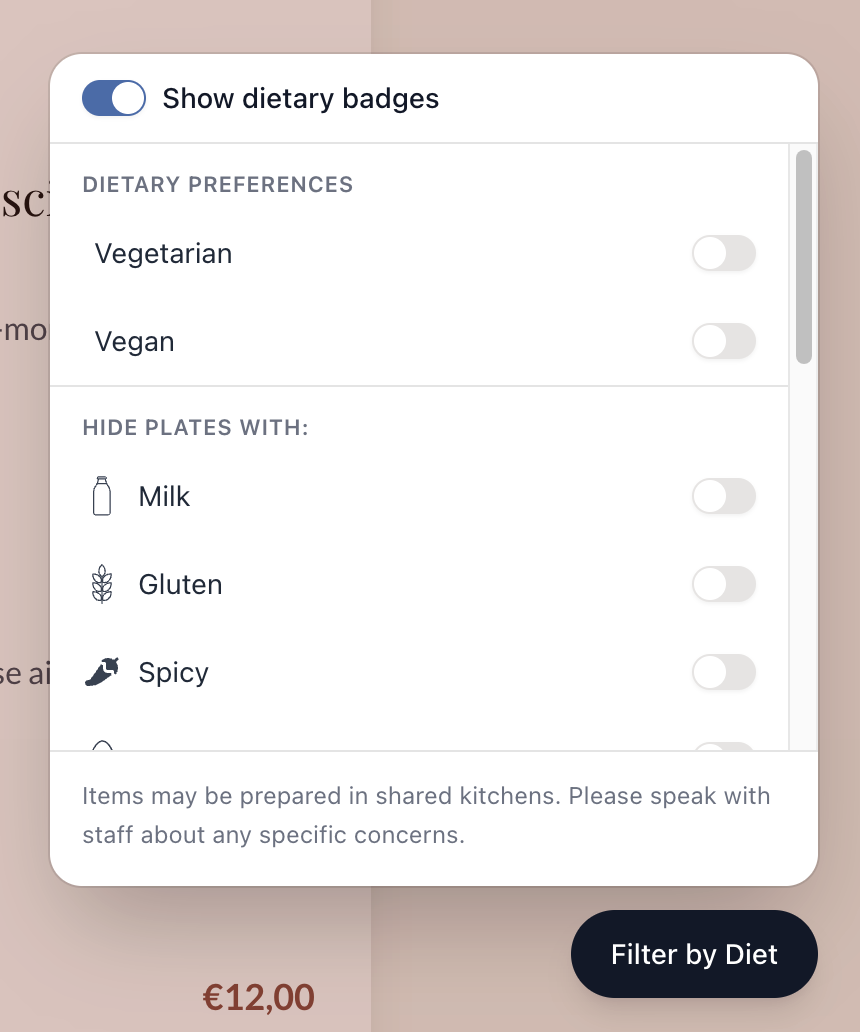
The standard, sensible approach is a general disclaimer on the menu, something like "Items may be prepared in shared kitchens. Please speak with staff about any specific concerns.", combined with staff who know to take those conversations seriously. Severely allergic diners know to ask; your job is to make sure the answer they get is informed.
How to Set This Up Without It Becoming a Second Job
The pattern that works for small restaurants:
- One source of truth. Your menu — the one customers actually see — carries the allergen information. Not a binder in the back, not a spreadsheet, not the chef's memory.
- Update at the moment of change. New supplier, new recipe, new garnish: the allergen labels change the same day, not at the next menu reprint.
- Official translations for every language you serve. If your menu is in three languages, your allergen information is too, in the regulation's own wording.
On paper, this is a lot of discipline. On a digital menu, it's a few taps.
How Solo Menus Solves This
Solo Menus has EU 1169/2011 allergen labeling built into the menu editor. For each dish, you tick which of the 14 allergens it contains. The list is exactly the Annex II list, so you can't accidentally invent a fifteenth or miss one.
From there, everything is automatic:
- Allergen badges appear on the dish, clearly separated from dietary labels like vegetarian and vegan
- Names use the official EU translations in English, Spanish, Portuguese, French and Italian, and standard Catalan food-safety terminology for Catalan (which has no official EU version), with no do-it-yourself translation risk
- On the Pro plan, diners can filter the menu to hide dishes containing their allergens, before they order and without flagging down staff
- A cross-contamination disclaimer is included on every menu, encouraging diners to speak with your team about specific concerns
- Changes publish instantly, so when a recipe changes, your menu is correct the same day, and your QR code never needs reprinting
If you don't have a website for your menu to live on yet, you can create one free in about ten minutes, allergen labeling included, on the free plan.